
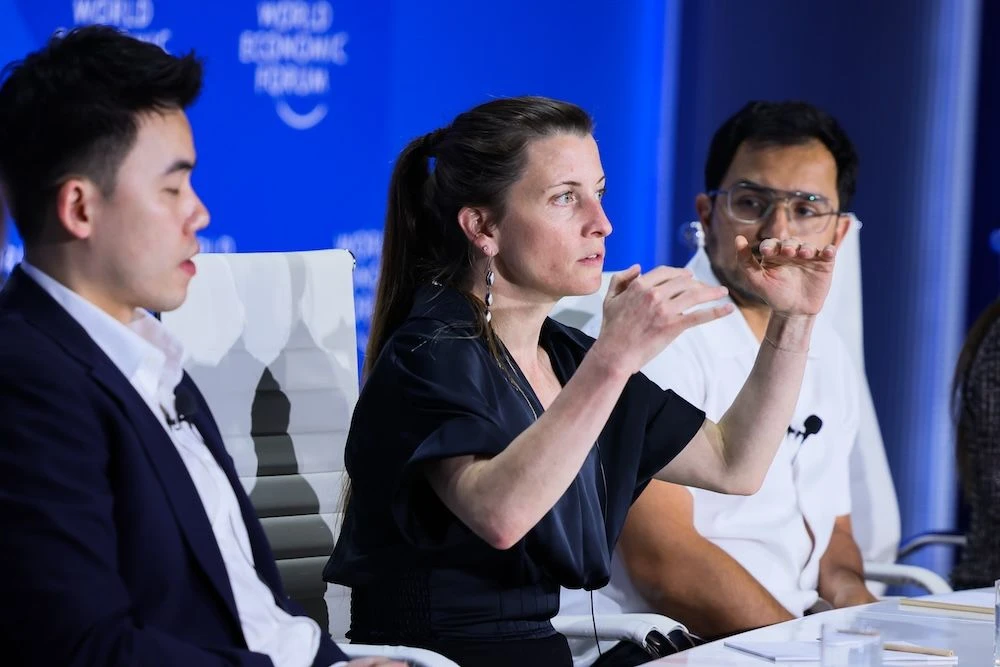
The World Economic Forum's Annual Meeting of the New Champions, better known as Summer Davos, convenes in China each year to bring together the founders and technologies that are poised to drive the next chapter of global progress. Our own Kathleen Alexander, co-founder and CEO of Savor, was selected as a WEF Technology Pioneer and attended this year’s edition in Dalian in late June. The multi-year program has a track record of identifying future disruptors, several of which have gone on to reach unicorn status. Summer Davos marked Kathleen’s and Savor’s first step, where she joined founders working in materials, energy, AI, and biology under the theme “Innovating at Scale.”
Throughout the week, conversations centered on how to scale emerging technologies quickly enough to take on humanity's biggest challenges. Across industries, founders shared how oftentimes their greatest challenge isn’t proving outa pioneering technology, but securing the financing needed to scale for impact. Discussions dug in on how Chinese versus Western financing models differ, how companies can maintain sustainability commitments even as near-term economics shift, and whether climate impact should account for supply chains, land, and biodiversity, rather than only carbon emissions.
Below, Kathleen reflects on what stood out from a week spent among founders and policymakers working towards similar goals from different starting points.
The interview
Interviewer: You’ve spoken about a catch-22 that you refer to as the "valley of death" where emerging technologies need to demonstrate sufficient demand in order to secure the financing needed to scale, while needing scale to drive prices down enough to drive demand. Did any conversations with other founders facing this quagmirechange how you think about it?
Kathleen: The one that stuck with me was a founder in China who told me about the 10,000-tonne first-of-a-kind facility they built entirely on government funding. They had de-risked the technology, and the government was willing to assess the technical opportunity and invest in the scale-up before market demand was established. That's the exact opposite of the Western scale-up story, where commercial demand has to be proven in advance. The trade-off is real — the government carries more risk, and not every scaled technology finds its market foothold — but the upside is that new technology reaches the market faster. What it changed for me is that I stopped reading the valley of death as a property of innovation. It's a property of who's willing to underwrite the first plant. China has spent a decade demonstrating that governments can fundamentally reshape the landscape.
Interviewer: Corporate sustainability commitments often shift with macroeconomic pressures. How can corporate coalitions and organizations like the World Economic Forum create structures that preserve commitments to sustainable alternatives even during periods when conventional agricultural commodities drop in price?
Kathleen: Sustainability commitments are voluntary, and a company's economic strength gives it the license to make and keep them. When macro conditions shift, what determines the impact on the bottom line is not just whether or not to follow through on a sustainability commitment, but also how a company evolves relative to its competitors. And that's where the type of convening that the WEF can accomplish matters most. A body like the WEF creates a space where companies state their commitments to their peers, see who else is carrying the same cost, and mutually reinforce one another. It’s also critical that these spaces are structured in a way that sharing intentions doesn't trip antitrust exposure. A neutral convener with good processes lets companies hold each other accountable for outcomes that are indirect rather than direct economic drivers, on the five-to-ten-year horizon they're planning resilience against, rather than a two-to-three-year cycle.
Interviewer: Any conversations with CPG folks that gave you a read on where big food companies' heads are at right now?
Kathleen: The tumult leaders are navigating on short timescales is real: tariff madness in the US, wars across the world causing supply chain shocks, the pressure not to get left behind in the AI revolution. But those are 3-24 month fires to fight. When looking further into the future, I heard the same three things over and over: Supply chain resilience; meeting consumer demand and scrutiny around nutrition; and moving from carbon targets and claims toward a broader lens on planetary health.
Interviewer: You've pointed out that carbon accounting often misses land-use and biodiversity impacts. Is that a shared frustration among the other climate-tech founders you met, or does Savor see it differently than most?
Kathleen: If you're decarbonizing cement or steel or power, production emissions are most of the impact, and calculating the mitigation opportunity is pretty straightforward. For anything that's produced from the land, the carbon footprint is an important contributing piece of the impact, but it is just a part of a much larger story that includes biodiversity and ecosystem health. This is a common theme in the food innovation space, but not as relevant for others where the potential to directly impact large land areas and ecosystems is less central to the value proposition.
Interviewer: You spoke at Summer Davos about how when there was more liquidity in the climate innovation market a decade ago, companies were striving to build the most efficient, small-scale factories possible, but that ultimately those factories were far too expensive for the companies to continue to build value. Savor chose to integrate into existing energy and industrial infrastructure in the interest of building scale. Does it seem like other founders you spoke with are following this approach?
Kathleen: A decade ago, the industry was recovering from climate tech 1.0, where investors took massive losses on projects whose technology hadn't been de-risked. The response was to build financing structures that could prove-out technology at subscale before going commercial. Financial markets no longer support that approach — today a facility that can't operate at positive margins doesn't get built.
What we see instead is companies turning to expensive toll or contract manufacturing. It preserves capital, but you can't demonstrate real process efficiency in someone else's plant, and you can't show cost-down on your COGS (Cost of Goods Sold). So, the only way to get a factory built is a long-term commercial agreement, which puts you right back to needing demand before you have scale.
The contrast in how this looks across industries represented at Summer Davos was striking: batteries, robots, vehicles, anything AI-adjacent — are being funded at large scale without the scrutiny and diligence required for climate technologies—no one is asking whether the market exists. Only a fraction of the tech pioneers and innovators in the room were in climate tech at all. How far a project can progress depends enormously on which field you're in and which investors show up for it.
The specifics of our process have allowed us to meet this challenge by integrating into existing energy and industrial infrastructure. I haven’t seen many others going this route, though the underlying strategy to reduce capital cost is not unique to us: find brownfield sites, look for spare capacity at existing industrial assets, work with partners who already have commercial infrastructure. The first plant should be as simple and boring as possible. It just needs to get built, and capital cost is what decides that.
For more, watch Kathleen’s panel discussion on jobs, skills, and sustainable growth at Summer Davos.
RSVP here to watch the upcoming World Economic Forum webinar “Green Technologies for Food Security: Advancing Sustainable and Resilient Agri-food systems” on September 1 at 7AM Central Time where Kathleen will discuss how Savor’s Carbon Crafted™ fats offer a complementary path toward more resilient food systems amid supply chain volatility.